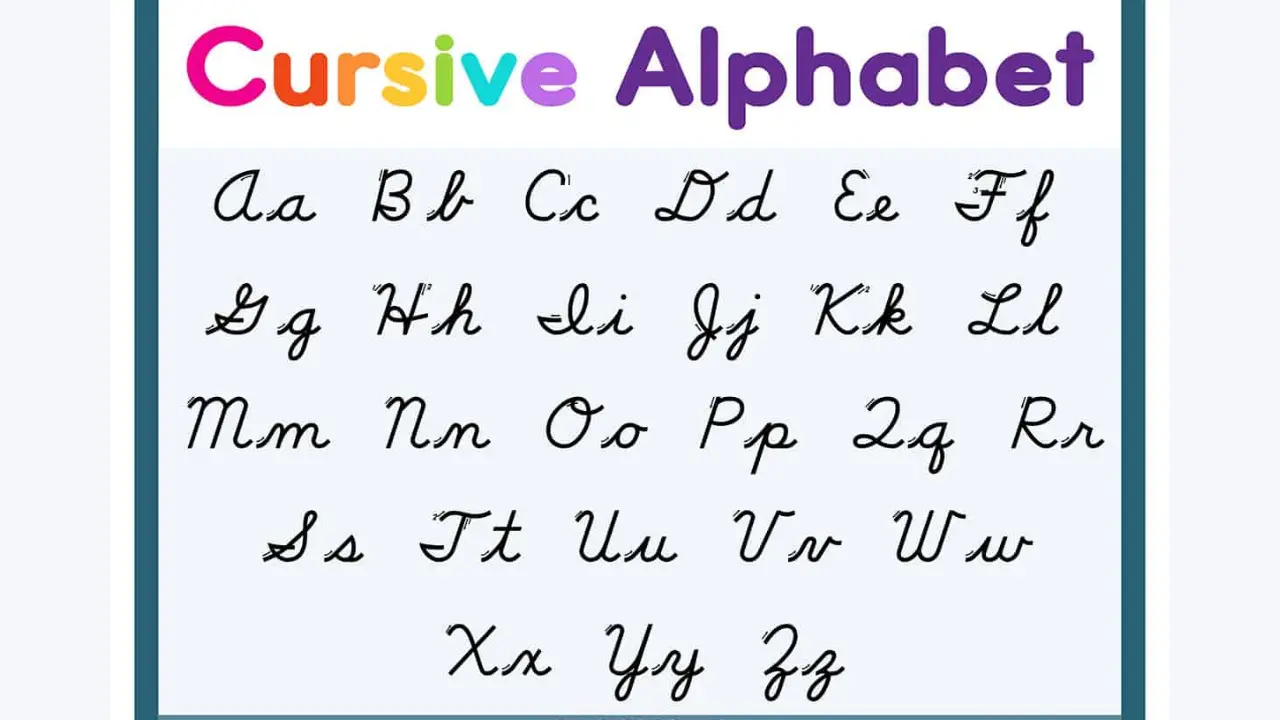
All Cursive Letters Uppercase and Lowercase Guide
All cursive letters are written with flowing strokes that usually connect one letter to the next. Learning the cursive alphabet starts with recognizing the shapes of lowercase and uppercase letters, then practicing the motions that make words smooth and readable. Cursive styles can vary by school, country, and handwriting method, so small differences in letter forms are normal.
All cursive letters at a glance
The cursive alphabet uses the same 26 letters as print writing. The main difference is the way each letter is formed and joined. Lowercase letters are used for most words, while uppercase letters are used at the beginning of sentences, names, and other proper nouns.
| Letter | Lowercase cursive | Uppercase cursive |
|---|---|---|
| A | a | A |
| B | b | B |
| C | c | C |
| D | d | D |
| E | e | E |
| F | f | F |
| G | g | G |
| H | h | H |
| I | i | I |
| J | j | J |
| K | k | K |
| L | l | L |
| M | m | M |
| N | n | N |
| O | o | O |
| P | p | P |
| Q | q | Q |
| R | r | R |
| S | s | S |
| T | t | T |
| U | u | U |
| V | v | V |
| W | w | W |
| X | x | X |
| Y | y | Y |
| Z | z | Z |
The characters in a standard digital font do not fully show handwritten cursive forms. A cursive worksheet or alphabet chart is useful because it shows stroke direction, starting points, loops, and connecting lines.
Cute Bubble Letters Easy Step-by-Step Guide for Beginners
How cursive writing works
Cursive is a style of handwriting in which letters are commonly linked in a continuous or nearly continuous motion. Most lowercase letters begin with a small entry stroke from the baseline and end with an exit stroke that leads into the next letter.
Not every letter must connect in every word. Writers may lift the pencil to cross a t, dot an i or j, or keep a difficult connection clear. Good cursive prioritizes legibility over keeping the pencil on the paper at all times.
Many teaching systems use slanted letters, but upright cursive also exists. The essential features are consistent letter shapes, proportion, spacing, and a comfortable rhythm.
Lowercase cursive letter families
It is often easier to learn lowercase cursive by stroke pattern instead of memorizing the alphabet in order. Letters built from similar movements can be practiced together.
Alphabet Bubble Letters Easy Steps, Styles & Tips for Beginners
Loop and overcurve letters
The letters i, t, u, w, e, l, b, h, and sometimes k use upward curves or loops. Begin with simple short letters such as i and u. Once those feel steady, move to taller letters such as l, b, and h.
Keep the height consistent. In standard lined handwriting, tall letters rise to the top line, while the main body of letters such as i, e, and u stays in the middle space.
Oval letters
The letters a, c, d, g, o, q, and often s are based on an oval or rounded counterclockwise movement. Practicing a row of even ovals helps build control for this family.
For a and d, form the oval first, then add the closing stroke or tall stem. For g and q, keep the descender below the baseline neat so it does not collide with the next line of writing.
Hump and turn letters
The letters m, n, r, v, x, and z often use repeated humps, turns, or angled strokes. These letters can look crowded when written too quickly. Leave a small, even space inside each hump and keep the exit stroke low enough to connect naturally.
The cursive r is especially easy to confuse with n or v. Make its short upward turn distinct, then move directly into the following letter.
Descending letters
The letters f, g, j, p, q, and y extend below the baseline. Their lower loops or tails should be similar in depth. A very long descender may make writing harder to read, especially on narrow-ruled paper.
Uppercase cursive letters need more variation
Capital cursive letters are less standardized than lowercase letters. A capital Q, Z, F, or S may look quite different across handwriting programs, yet still be correct if it is clear and used consistently.
Start capital letters separately rather than trying to force them into a word immediately. Write the capital, pause if needed, then add the rest of the name or sentence in connected lowercase letters. This is common in everyday cursive.
Some capital forms resemble print letters more closely, including many versions of C, O, P, U, V, W, and X. Others use decorative loops that require extra practice. If a particular school or workbook requires a specific style, follow its model; mixing styles is more likely to confuse a learner than choosing one clear system.
How to form readable cursive words
After practicing individual letters, work on short combinations. The goal is not speed at first. Aim for a steady shape and an easy connection between letters.
- Use ruled paper. The baseline and height guides make it easier to keep letters proportional.
- Practice basic strokes. Make rows of curves, ovals, loops, and humps before writing full letters.
- Learn lowercase letters by family. Repeat a few similar letters until the movement feels familiar.
- Join two-letter patterns. Try combinations such as ai, on, th, in, and er.
- Write short words. Simple words such as cat, time, sun, and hello provide useful connection practice.
- Add capitals and sentences. Practice names, then short sentences with normal spaces between words.
- Increase speed only after the shapes are clear. Faster writing should not flatten, tangle, or distort the letters.
Common cursive connections
Most connections are made near the baseline. The finishing stroke of one lowercase letter flows into the starting stroke of the next. For example, in an, the exit stroke from a leads naturally into the first hump of n.
Some joins need attention because they can become unclear. The combinations th, br, bl, oo, and st should be practiced slowly. In words with double letters, such as little or happy, make each letter distinguishable rather than drawing one long unbroken wave.
Writers also commonly lift the pencil to add dots and crossbars after writing a word. This makes the word easier to form and does not make it less cursive.
Letters that are often confused
A few cursive letters cause predictable reading and writing problems. Paying attention to their identifying marks improves both skills.
- a and o: A cursive a has a closing stroke; an o is usually a more open, continuous oval.
- e and l: Both may begin with a loop, but l rises to the top line while e remains short.
- n, m, and r: Count humps carefully. The r has a shorter, sharper turn.
- u and w: A w usually has an extra turn or hump.
- g, q, y, and z: Their descenders vary widely by style. Use the form shown in the handwriting system you are learning.
- capital I, J, and T: These can be highly stylized, so context often helps identify them in older handwriting.
Tips for better cursive handwriting
Clear cursive comes from repetition and control, not elaborate flourishes. Hold the pencil in a relaxed way, keep the paper at a comfortable angle, and use light pressure. Tension in the hand often leads to shaky lines and cramped letters.
Focus on four habits: consistent slant, even letter height, open loops, and regular word spacing. A reader should be able to tell where one word ends and the next begins. Decorative loops are optional; clean, simple letterforms are usually easier to read.
Copying a short model sentence can help, but avoid tracing forever. Once a pattern is familiar, write it from memory. That is how the movement becomes part of natural handwriting.
Print, cursive, and signature writing are not the same
Print writing forms letters separately. Cursive usually links them. A signature may use cursive-like strokes, abbreviations, or personal marks that do not follow a full cursive alphabet. A signature only needs to be a consistent personal mark; it does not need to be easily readable or written in textbook cursive.
Older handwritten records may use styles such as Spencerian or Palmer writing, which can look more ornate than modern classroom cursive. Familiarity with basic cursive helps, but reading historic handwriting often requires practice with the particular writer and period.
Frequently asked questions
How many cursive letters are there?
English cursive has 26 lowercase and 26 uppercase letters, just like the printed English alphabet. Their shapes and connections are the main differences.
Do all cursive letters have to connect?
No. Most lowercase letters connect within a word, but writers often lift the pencil to dot i and j, cross t, or keep a word legible. Capital letters may also stand apart from the following lowercase letter.
Why do cursive capital letters look different on different charts?
There is no single universal cursive style. Handwriting methods teach different forms, especially for capitals such as Q, S, Z, F, and T. Use one model consistently while learning.
What is the best order for learning cursive?
Begin with basic strokes and lowercase letter families, then practice common joins and short words. Add capitals after the lowercase forms feel comfortable.
Is cursive still useful?
Cursive can be useful for handwriting fluency, reading personal notes, and understanding many historical documents. It is also one way to develop an individual signature style, though a signature does not have to be cursive.
Building confidence
Learning all cursive letters is mainly a matter of recognizing patterns and practicing them in small steps. Choose a consistent alphabet model, form each letter clearly, and work from strokes to letters, joins, words, and sentences. With regular practice, cursive becomes less about memorizing shapes and more about developing a smooth, readable rhythm.