WordHippo 5 Letters Uncommon, Regional, Technical
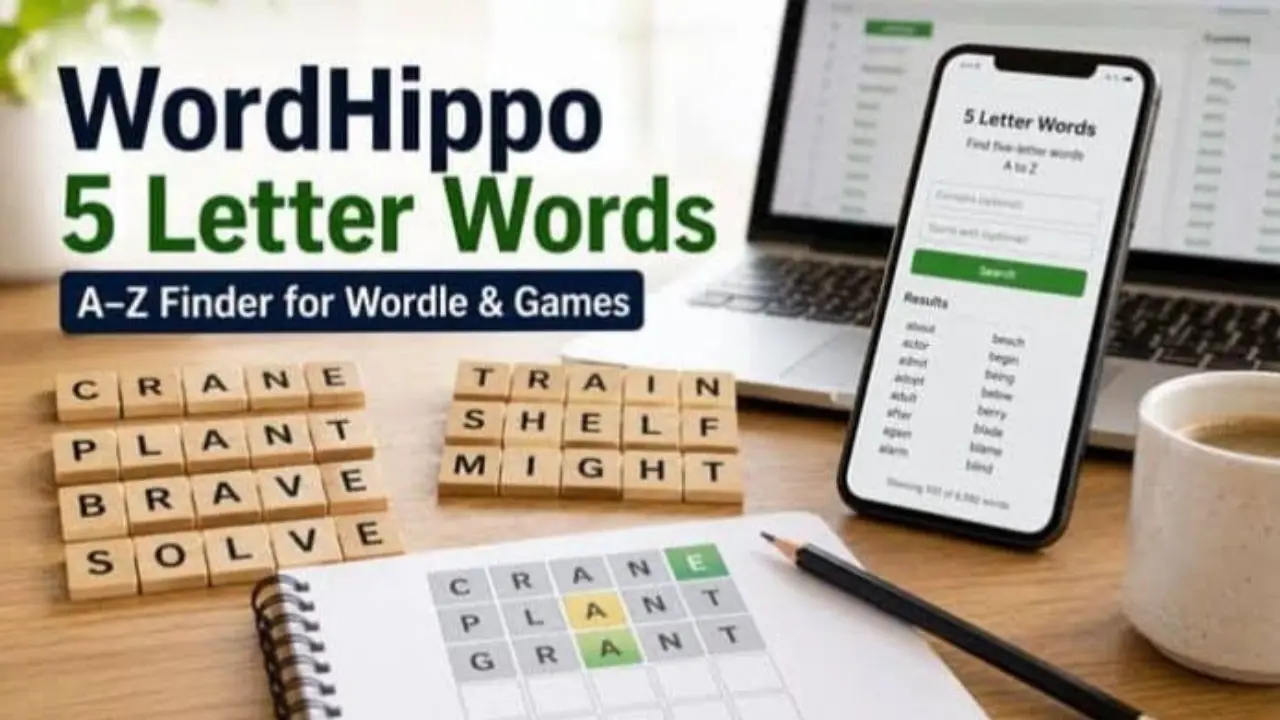
WordHippo 5 letters usually refers to using WordHippo’s word-finding pages to look up five-letter words. It is useful when you know part of a word, need a word that starts or ends with certain letters, are solving a crossword clue, or want ideas for a word game. The most effective method is to choose the search type that matches the information you already have, then narrow the results by length and letter position.
Five-letter words are common in puzzles and games, but a long list alone is rarely the answer. A pattern such as _ A _ E _, a known ending such as -IGHT, or a set of letters that must be rearranged can reduce the possibilities much faster.
What WordHippo can help with
WordHippo is an online word-reference tool with pages for finding words by length, beginning letters, ending letters, contained letters, meanings, synonyms, rhymes, and other language relationships. For a five-letter-word task, the relevant tools are usually its word-length lists and letter-based word finders.
The right option depends on the clue or puzzle rule. Start with the most specific fact you have. Knowing a word ends in two letters is more useful than browsing every five-letter word; knowing the exact placement of three letters is more useful still.
| What you know | Useful search approach | Example |
|---|---|---|
| Only the length | Browse five-letter words | You need a general word list for practice or ideas. |
| The first letter or letters | Find five-letter words beginning with those letters | cr___ |
| The final letter or letters | Find five-letter words ending with those letters | ___er |
| Letters in fixed positions | Use a pattern or wildcard-style search, where available | _ r a _ e |
| A group of letters to rearrange | Use an anagram or unscramble tool | Letters that can form a five-letter answer |
| A definition or clue | Use meaning, synonym, or related-word tools | “A small stream” |
How to find five-letter words efficiently
Begin by writing down the puzzle’s hard constraints: word length, letters confirmed to be present, letters confirmed to be absent, and any letters already fixed in a position. This prevents a broad search from becoming a guess-and-check exercise.
- Confirm the length. Select or search for words with exactly five letters. Do not assume a hyphenated term or phrase counts as a single five-letter answer unless the puzzle says so.
- Use known beginning or ending letters. If the answer begins with st, look for five-letter words beginning with those letters. If it ends in ing, find five-letter words ending in that sequence.
- Apply a letter pattern. Treat unknown positions as blanks. For example, a pattern like p _ a _ e shows that the first, third, and fifth letters are known while two positions remain open.
- Check the clue’s grammar. A crossword clue written in the plural generally calls for a plural answer. A past-tense clue often points to a past-tense verb. The grammar can eliminate otherwise valid letter matches.
- Read definitions before submitting an answer. A word may fit the pattern but not the meaning, spelling convention, or part of speech required by the clue.
For word games with a limited number of guesses, avoid using a finder to throw random results at the puzzle. Use your confirmed letter information to compare a short list of candidates and choose a word that matches every rule.
Cute Bubble Letters Easy Step-by-Step Guide for Beginners
Using letter patterns correctly
A pattern search is most helpful when at least two or three positions are known. Think of a five-letter word as five slots. Each confirmed letter belongs in one slot; each blank can be any permitted letter.
For instance, if a clue produces _ O _ N _, the second letter must be o and the fourth must be n. A candidate with those letters in different positions does not fit, even if it contains both letters. This distinction matters in Wordle-style games, crosswords, and fill-in puzzles.
Known letters versus possible letters
Keep two separate notes. One list should contain letters that must appear in the answer and their known positions. The other should contain letters that are possible but unconfirmed. A third list can hold excluded letters, if the game provides them.
Repeated letters require extra care. If a puzzle indicates that one e is present, it does not automatically prove that the answer contains only one e. Conversely, a candidate with a repeated letter may be wrong if the puzzle’s feedback rules rule out a second occurrence. Check the rules of the particular game before filtering results.
Beginning, ending, and containing letters are different searches
These options sound similar but answer different questions. Choosing the wrong one can hide the word you need or return far too many results.
- Beginning with fixes letters at the start. A five-letter word beginning with br has b in position one and r in position two.
- Ending with fixes letters at the end. A five-letter word ending in ash has those three letters in positions three through five.
- Containing means the letters occur somewhere, not necessarily next to each other or in a particular order.
- Containing in order, when a tool offers that option, normally means the letters appear left to right but may have other letters between them.
Suppose you need a five-letter word with a and r. A “contains” search can be a useful starting point. If you know it ends in ar, an ending search is much better because the letter positions are fixed.
Alphabet Bubble Letters Easy Steps, Styles & Tips for Beginners
When an anagram finder is the better choice
Use an anagram or unscramble finder when you have a set of tiles or scrambled letters and the order does not matter. A five-letter anagram search should use all five available letters unless the game permits leaving letters unused.
An anagram tool is not the same as a pattern finder. With an anagram, the supplied letters determine what can be built. With a pattern, the known letters stay in particular places, while unknown positions can be filled with other letters. Mixing up these two puzzle types is a common reason for getting irrelevant results.
How to narrow a large list of results
Even a five-letter list can contain many uncommon, regional, technical, or inflected words. Use the puzzle context to decide which result is most likely.
- Match the definition first. A precise clue usually favors a word with a matching dictionary sense, not merely a related idea.
- Match the part of speech. A clue asking for an action needs a verb; a clue asking for a person, place, or thing generally needs a noun.
- Watch singular and plural forms. Many ordinary plurals are longer than five letters, but some five-letter plural answers occur. Cross letters and clue grammar matter.
- Consider spelling variants carefully. British and American spellings can differ. Use the convention suggested by the publication or puzzle.
- Prefer ordinary vocabulary unless the clue signals otherwise. A specialized answer may be correct, but a general puzzle usually provides a definition or cross letters that support it.
For Scrabble-style games, word-list eligibility can differ from everyday dictionary use. A word that appears in a general word finder is not automatically legal under every game’s official lexicon or tournament rules. Check the rules and approved word list for the game being played.
Common mistakes when looking for five-letter answers
Searching too broadly: Looking through a full list of five-letter words may help with brainstorming, but it is slow once any letters are known. Switch to a beginning, ending, pattern, or anagram search as soon as you have a constraint.
Ignoring letter position: A result can contain every visible letter and still fail the puzzle because the letters are in the wrong slots. Recheck each of the five positions before choosing it.
Forcing an answer to fit: A near-synonym may not satisfy the exact clue. Check whether the word has the required meaning, tense, number, and spelling.
Overlooking multiword answers: Some crosswords use spaces, punctuation, abbreviations, or proper names in ways that differ from a simple word finder. Follow the puzzle’s stated conventions and the crossing entries.
Assuming every result is familiar: Word lists may include rare terms. An unfamiliar word deserves a definition check, especially if it is the only apparent match.
Five-letter word strategies for different puzzles
Crosswords
Use the enumeration and crossing letters as fixed constraints. Then compare candidate definitions with the clue’s wording. Watch for abbreviations, wordplay, tense, and plural forms; a direct letter search cannot interpret those details on its own.
Wordle-style games
Enter confirmed positions as a pattern, include letters known to be present but not yet placed, and remove letters the game has ruled out. Do not assume a yellow letter can never appear twice; the feedback system and your previous guesses must be interpreted carefully.
Scrambled-letter and tile games
Use an anagram finder and set the answer length to five. Then verify the game’s word-list rules, especially for unusual words, abbreviations, and proper nouns.
Writing and vocabulary work
A five-letter word list can be useful for poetry, naming exercises, classroom activities, and concise writing. In these cases, meaning and tone are usually more important than simply meeting the length requirement. Synonym and rhyme tools can help refine the final choice.
Frequently asked questions
How do I find a five-letter word with certain letters?
Use a letter-based finder, then set the length to five. Choose “contains” if the letter positions are unknown, “begins with” or “ends with” if they are fixed, or a pattern search when you know exact slots.
Can I use WordHippo to solve a five-letter anagram?
Yes. An anagram or unscramble tool is appropriate when you have the available letters and need to rearrange them into a five-letter word. Check that every required tile is used and that the result is allowed by the game.
Why does a word fit the letters but not the clue?
Letter fit is only one condition. The answer may have the wrong meaning, part of speech, tense, number, or spelling variant. In crosswords, crossing letters may also reveal that a seemingly good candidate is wrong.
Are all five-letter words shown in a word finder valid in every game?
No. Different games can use different official word lists and may exclude proper nouns, abbreviations, offensive terms, or regional variants. Use the game’s rules as the final authority.
Finding
WordHippo 5 letters tools work best as a way to narrow possibilities, not as a substitute for the clue or game rules. Start with the exact length, add every known letter and position, choose the correct type of search, and verify the definition or permitted word list. That approach turns a large word list into a short set of realistic answers.