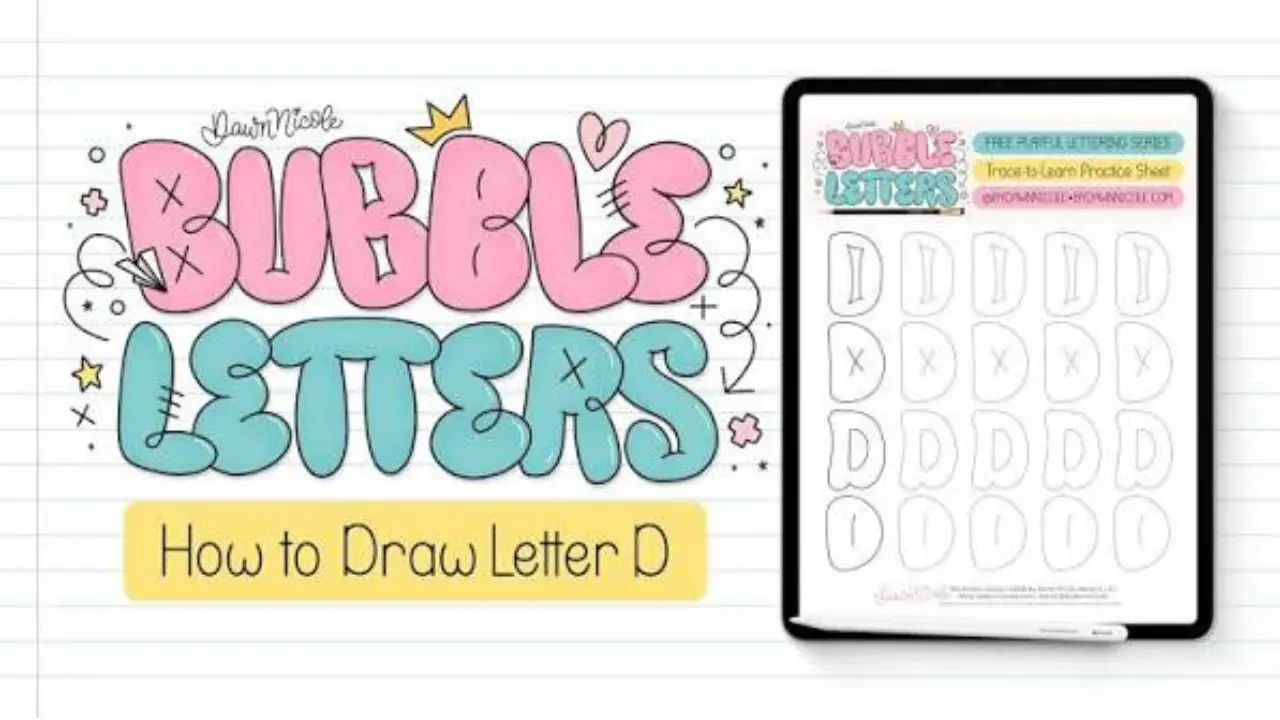
Bubble Letters D Draw and Style
Bubble letters D are rounded, thick versions of the letter D that look soft, puffy, and playful. They are popular for posters, school projects, coloring pages, signs, graffiti-inspired art, and hand lettering. You can draw them as a capital D or lowercase d, then add outlines, shadows, patterns, and color to make the letter stand out.
The easiest approach is to begin with a large block-letter D, round off its corners, and give the strokes enough width to resemble an inflated shape. A pencil sketch makes it simple to adjust the proportions before tracing the final lines.
What makes a letter D a bubble letter?
A bubble letter has thick strokes, smooth curves, and rounded ends or corners. Unlike a narrow printed D, it should look full and soft. The interior opening, called a counter, is usually rounded as well.
For an uppercase D, the left side is a tall vertical stroke and the right side is one broad curve. For a lowercase d, the shape usually has a round bowl with a tall upright stem. Keeping these main parts wide and rounded preserves readability even after you decorate the letter.
How to draw bubble letters D step by step
Start with the uppercase form if you are new to bubble lettering. Its simple structure makes it easier to practice even line thickness and clean curves.
Cute Bubble Letters Easy Step-by-Step Guide for Beginners
Draw an uppercase bubble D
- Sketch a tall guide shape. Lightly draw a vertical rectangle to set the height and width of the letter.
- Make the left stroke thick. Draw two close, vertical lines with gently rounded top and bottom ends. This creates the solid left side of the D.
- Add the outer curve. From the top of the vertical stroke, sweep a large rounded line to the right, down, and back toward the bottom of the stroke. Think of a wide backward C joined to the vertical side.
- Draw the inner opening. Inside the outer shape, add a smaller curved opening. Leave a consistent band of space between the inner and outer lines.
- Round and refine. Erase sharp corners, uneven edges, and guide marks. The letter should look balanced, with a broad curve rather than a pointed or flat right edge.
- Trace the final outline. Use a dark pencil, pen, or marker once you like the shape.
Draw a lowercase bubble d
- Draw a large round or oval bowl near the bottom of your drawing area.
- Add a smaller oval inside it to create the opening.
- From the bowl’s right side, draw a thick vertical stem that rises above the bowl.
- Round the stem at the top and smoothly connect it to the bowl.
- Check that the bowl remains clearly round and that the stem is thick enough to match the rest of the letter.
A lowercase bubble d can resemble a balloon on a stick. That simple mental picture helps keep its bowl and stem distinct.
Alphabet Bubble Letters Easy Steps, Styles & Tips for Beginners
Keep the shape even and easy to read
The most common challenge with bubble letters is maintaining a consistent width. If one part of the D is much thinner than another, it may look more like an ordinary outlined letter than a bubble letter.
- Use faint guide lines for the top, middle, and baseline.
- Leave a similar amount of space around the inner opening.
- Make the outer curve wide enough that the D does not look squeezed.
- Choose rounded joins where the vertical stroke meets the curved section.
- Step back from the page before tracing; uneven shapes are easier to spot from a distance.
Do not worry about perfect symmetry. Hand-drawn bubble lettering often looks more lively when it has small, intentional variations.
Easy styles for bubble letters D
Once you have a clear outline, the same basic D can take on many different looks. Decoration works best after the form is readable, not before.
| Style | How to create it | Best use |
|---|---|---|
| Simple outline | Use one bold outer line and leave the center white. | Coloring pages, worksheets, clean signs |
| Double outline | Add a second line just inside or outside the main edge. | Posters and decorative headings |
| 3D block effect | Extend a second copy of the outline slightly down and to one side, then join the edges. | Names, banners, comic-style art |
| Shadowed D | Add a darker band or gray shadow along one lower edge. | Quick depth without complex drawing |
| Pattern-filled D | Fill the letter with dots, stripes, stars, checks, or small shapes. | Crafts and personalized designs |
| Highlight effect | Leave small white curved marks near the upper left of the letter. | A shiny, balloon-like appearance |
Make a 3D bubble D
A 3D effect adds depth while keeping the front of the letter rounded. First, complete the front-facing D. Then lightly copy its outer edges a short distance down and to the right, or down and to the left. Connect matching points with short lines and shade the side surfaces more darkly than the front.
Keep the depth direction consistent. If the top of the letter extends down-right, the bottom and curved edge should extend down-right too. Mixed directions make the letter appear twisted.
Add shine without overfilling the letter
For a glossy look, place one or two small white ovals, curved dashes, or crescent shapes near the upper-left area of the letter. Color around them rather than drawing over them. Pair the highlight with a slightly darker shade near the lower-right edge for a simple light-and-shadow effect.
Color ideas and materials
Colored pencils, crayons, markers, gel pens, and paint can all work well. The material changes the finish more than the letter shape itself.
- Crayons: Good for young artists and soft, textured color.
- Colored pencils: Useful for gradients, shadows, and controlled details.
- Markers: Create strong, solid color but may bleed through thin paper.
- Gel pens: Helpful for bright accents, dots, and highlights over darker colors.
- Paint: Works well on heavier paper when making a large sign or display.
Try two shades of the same color: use the lighter shade on the main face of the D and the darker shade for a lower edge or 3D side. Complementary color combinations can also make the outline pop, but a dark outline around a light fill is usually the clearest choice.
Printable and digital options
For a quick printable design, draw or type a large capital D in a bold rounded font, print it as an outline, and color it by hand. Check the print preview first so the letter does not get cut off near the page edges.
In a drawing or design app, create the letter with a heavy rounded typeface, then adjust its outline, fill, and shadow. If you plan to cut it out, leave a plain border around the outside. A simpler outline is easier to cut neatly than a letter covered in tiny details.
Common mistakes to avoid
A bubble D does not need to be complicated. In fact, too much detail can hide the letter shape. Watch for these issues while drawing:
- A narrow right curve: Widen it so the uppercase D looks rounded rather than cramped.
- An off-center opening: Keep the inner opening comfortably inside the outer shape, with visible space around it.
- Sharp corners: Soften the joins and ends for a more inflated look.
- Inconsistent line width: Use guide lines or redraw the thinner areas before inking.
- Too many patterns: Leave some open space so the letter remains readable at a glance.
- Shading in conflicting directions: Pick one imaginary light source and keep highlights and shadows consistent.
Frequently Asked Questions
How do you make a bubble letter D look more puffy?
Use broad, rounded strokes and smooth curves. Add a small white highlight near one upper edge and a darker shadow along the opposite lower edge to create the look of volume.
Should the inside of a bubble D be a circle?
Not necessarily. The inner opening of an uppercase D is usually a rounded oval or curved D-shaped space. What matters most is that it follows the outer curve and leaves an even-looking border.
Can bubble letters be lowercase?
Yes. Lowercase letters can be drawn in bubble style by widening their strokes, rounding their corners, and keeping their normal letter structure clear. A lowercase d usually has a round bowl and a tall rounded stem.
What is the easiest way to outline a bubble letter?
Sketch the shape lightly in pencil first, then trace it with a black marker or darker pencil. Move slowly around curves and rotate the paper if that helps you keep a steady line.
How can children practice drawing bubble letters?
Start with large letters on blank paper and use simple pencil guides. Tracing a bold printed outline can also help children understand the spacing between the outer shape and the inner opening before they draw freehand.
Conclusion
Bubble letters D begin with one clear idea: turn the familiar letter into a thick, rounded form. Sketch a wide vertical stroke, add a generous outer curve, and keep the inner opening balanced. From there, color, a double outline, a shadow, or a few highlights can give your bubble letters D their own personality without making them hard to read.